
Stinging insect · Vespula vulgaris / Vespula germanica · Last updated 24 August 2026
Wasps
An active wasp nest can hold up to 5,000 individuals in August. Nestled in an attic, cavity wall, under a roof or in the ground, it becomes dangerous as soon as it sits near a walkway.
On site within 24h
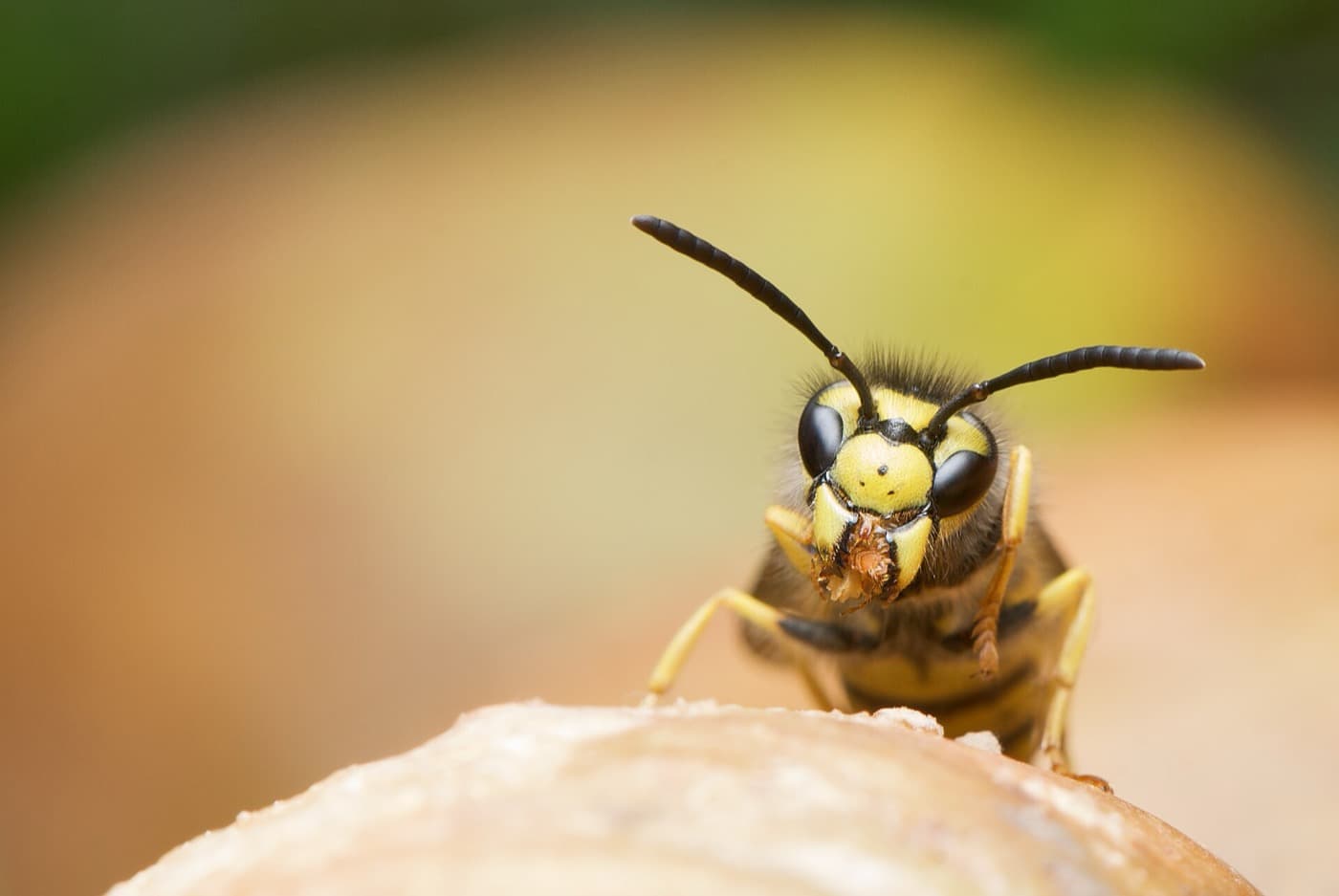
Common wasps (Vespula vulgaris and Vespula germanica) turn aggressive in late summer, when the colony peaks. Multiple stings can cause anaphylactic shock in sensitised people. Nest destruction is carried out with a protective suit and a suitable insecticide, preferably early morning or in the evening when the colony is inside. For hornets, larger and more defensive, see our dedicated page.
Identify
Signs of infestation
- Steady back-and-forth wasp traffic to one fixed point on a facade, eave, dormer or ground burrow
- A greyish paper nest (chewed wood fibres) visible: fist-sized in May, football-sized by August
- More wasps noticed indoors in late summer (a sign of a nest in the roof or an adjoining loft space)
- Round holes, 1 to 2 cm, in garden soil or lawn indicating an underground nest
Where it's found
The common wasp (Vespula vulgaris) and the German wasp (Vespula germanica) nest in wall cavities, attics, lean-tos, under decking and in underground nests. Annual cycle: the queen emerges in March, the nest reaches several thousand workers by August, and the colony dies at the first frost (the nest is never reused the following year).
Impact
Associated risks
Allergy risk
2 to 3% of the Belgian population is hypersensitive to wasp venom. A single sting can trigger anaphylactic shock. EpiPens should be on hand for sensitised individuals.
Late-season aggression
August-September: the declining colony becomes highly aggressive. Workers with no queen left to protect sting for no apparent reason. The most dangerous period to intervene without equipment.
Structural damage
Nests in the attic can reach 60 cm. As the nest is rebuilt, it damages insulation and plaster. An underground nest beneath a slab can cause gradual subsidence.
Good practice
Prevention
- 01Inspect roofs, eaves and vents in April-May: a golf-ball-sized new nest is harmless, an August one is not
- 02Seal unused vent openings with fine mesh in autumn, once you've confirmed no overwintering queen is present
- 03Keep sugary drinks and food away outdoors in summer: wasps are drawn to fermented sugars and meat
Frequently asked questions
What you're asking
When should I call a professional for a wasp nest?
As soon as the nest is active and near a walkway — window, entrance, play area. An August nest can hold 5,000 individuals. Attempting removal without proper protection (suit, mask) is dangerous even for healthy adults.
Wasp or hornet: how do I tell them apart?
The common wasp measures 1 to 2 cm, bright yellow with black stripes. The hornet is distinctly larger (up to 3–3.5 cm) and more brownish-orange. Both can sting repeatedly, but the hornet defends its nest far more aggressively and requires a dedicated intervention — see our Hornets page.
Can I leave a wasp nest alone at the end of the season?
A nest abandoned in November won't reactivate the following year — wasp colonies aren't perennial. But removing it prevents it from serving as shelter or an attraction for new colonies. Early removal (May-June) is simpler and less risky.
Insect Control
Related pests
wasps problem?
Intervention within 24h, price confirmed before treatment.