
Textile insect · Tineola bisselliella
Clothes moths
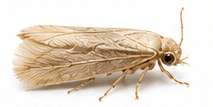
The clothes moth (Tineola bisselliella) attacks natural fibres — wool, cashmere, silk, feathers. It barely flies and goes unnoticed. It's the larvae, not the adult, that cause the damage by gnawing keratin fibres.
An infested home can lose hundreds of euros' worth of clothing before detecting the problem. Treatment combines pheromone traps for monitoring, contact insecticide in storage areas, and freezing or professional cleaning of the affected items. The eggs resist ordinary insecticides — hence the need for a 6-to-8-week follow-up.
Identifier
Signes d'infestation
- Trous irréguliers dans les lainages, cachemires et soies (jamais dans les fibres synthétiques)
- Tubes soyeux ou cocons blanchâtres dans les plis de vêtements ou au fond d'un tiroir
- Petit papillon doré pâle de 6 à 8 mm volant bas et lentement dans la pièce, surtout le soir
- Dégâts en arrière des revers, aux épaules et dans les zones non portées des vêtements
Zones de présence
La mite des vêtements (Tineola bisselliella) ne se nourrit pas à l'état adulte : seule la larve est destructrice. Elle prospère dans les armoires sombres, tièdes et non perturbées, sur les vêtements non lavés. Les moisissures et traces de transpiration non lavées sont les sites privilégiés de ponte.
Impacts
Risques associés
Dégâts irréversibles
Les larves digèrent la kératine (laine, soie, duvet, poils d'animaux). Les dégâts sont irréversibles. Une seule femelle pond 50 à 200 oeufs : une saison d'infestation non détectée peut détruire une garde-robe entière.
Diffusion rapide
Les adultes diffusent rapidement entre pièces. Un vêtement de seconde main non traité suffit à contaminer une armoire entière. Les larves peuvent aussi se nourrir de tapis naturels et tapisseries.
Bonnes pratiques
Prévention
- 01Laver ou nettoyer à sec TOUS les vêtements de laine, cachemire et soie avant rangement saisonnier
- 02Traitement froid alternatif : placer les pièces en sac hermétique 48h au congélateur à -18°C (élimine larves et oeufs)
- 03Stocker les vêtements saisonniers dans des housses respirantes hermétiques, jamais en carton ouvert
- 04Cèdre, lavande et phéromones : répulsifs utiles à la détection précoce, pas des traitements en cas d'infestation active
Questions fréquentes
Ce que vous demandez
How do I know if I have clothes moths?
The first signs are irregular holes in wool or cashmere clothing, silky threads in the folds, and brown flakes (larval casings). The adults are small beige moths of 6–8 mm that flee the light. Pheromone traps confirm the infestation.
Are clothes moths dangerous to health?
No, clothes moths don't bite and don't transmit diseases. Their impact is purely material: irreversible damage to wool, cashmere, silk, feathers and furs. An untreated infestation can destroy an entire wardrobe in a few weeks.
Are shop-bought repellents (cedar, lavender) effective?
Not against an established infestation. These products have a marginal preventive effect but eliminate neither larvae nor eggs. Professional treatment is essential as soon as damage is visible, because the larvae hide in seams, folds and dark areas that consumer sprays can't reach.
Problème de clothes moths ?
Intervention sous 24h, garantie incluse.