
Flying insect · Vespa crabro / Vespa velutina
Hornets
The European hornet (Vespa crabro) and the Asian hornet (Vespa velutina), now established in Belgium, build nests that can shelter several thousand individuals. Larger and more imposing than wasps, they defend their nest aggressively.
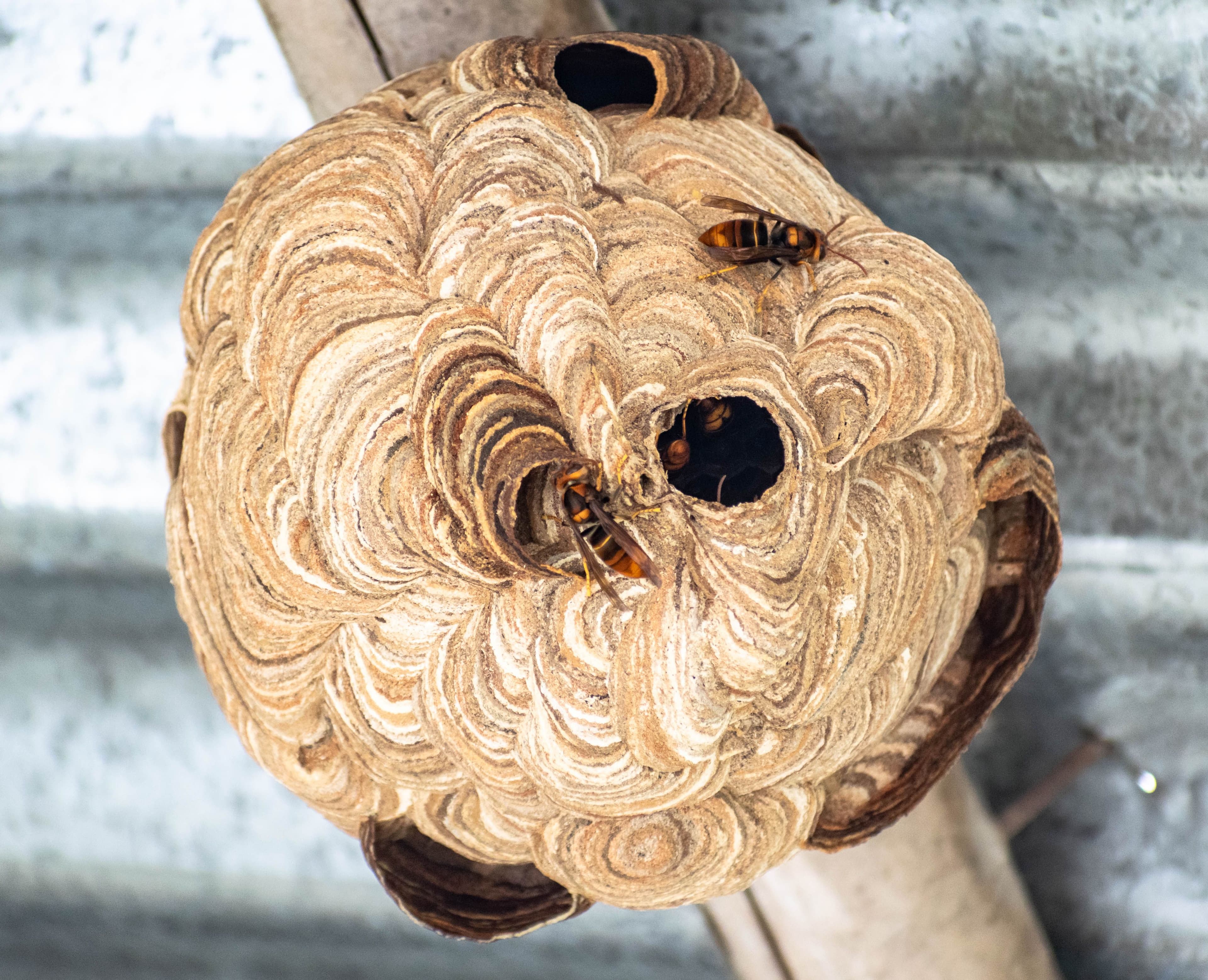
Hornets nest high up — roof frames, chimneys, trees, cavities — and become dangerous as soon as the nest is approached. Their repeated, painful stings can cause severe reactions, especially in allergic people. The Asian hornet, an invasive alien species, also threatens bee colonies. Destroying a nest requires full protective equipment and a telescopic lance — never attempt it alone. Antinox neutralises the nest then removes it depending on its location.
Identifier
Signes d'infestation
- Vol bruyant et lourd, nettement plus sonore que la guêpe : le son seul permet souvent de les distinguer à distance
- Grand nid en papier grisâtre de 30 à 50 cm de diamètre (frelon européen) ou sphérique plus petit haut dans les arbres (frelon asiatique)
- Frelon européen : abdomen jaune et brun, tête orange-rousse, envergure 40 mm
- Frelon asiatique : corps entièrement brun-noir, seule la bande abdominale est orange, pattes jaunes à l'extrémité. À ne pas confondre avec le frelon européen
Zones de présence
Frelon européen (Vespa crabro) : creux d'arbres, combles, intérieur de toiture. Frelon asiatique invasif (Vespa velutina) : nids hauts dans les arbres (6 à 20 m), parfois sous les avant-toits. Le frelon asiatique est une espèce invasive en Belgique depuis 2016. Son signalement est encouragé sur Vespa-Watch.be.
Impacts
Risques associés
Venin plus puissant
La piqure de frelon est plus douloureuse et injecte un volume de venin supérieur à la guêpe. Le choc anaphylactique reste le risque principal. Ne jamais approcher un nid sans équipement de protection complet.
Frelon asiatique (espèce invasive)
Vespa velutina est un prédateur efficace des abeilles domestiques et sauvages, menaçant la pollinisation. Espèce classée invasive en Belgique. Le signalement de nids sur Vespa-Watch.be est vivement encouragé.
Bonnes pratiques
Prévention
- 01Inspecter les abords d'arbres et avant-toits en mai-juin : un nid naissant de la taille d'une balle de tennis est sans danger réel, celui de septembre ne l'est plus
- 02Signaler les nids de frelons asiatiques sur Vespa-Watch.be : les autorités coordonnent l'intervention et la suppression
- 03Ne jamais tenter de détruire un nid de frelons seul : la colonie compte 200 à 700 individus et devient extrêmement agressive si elle est dérangée
Questions fréquentes
Ce que vous demandez
How do I tell the Asian hornet from the European hornet?
The Asian hornet (Vespa velutina) is darker: black thorax, brown-black abdomen with a single broad orange band, and yellow leg tips. The European hornet (Vespa crabro) is larger, russet-brown and yellow, like an oversized wasp. The Asian nest is often spherical and perched very high in trees.
What do I do if I find an Asian hornet in Belgium?
The Asian hornet is an invasive alien species. It's recommended to report any individual or nest via the regional reporting platform, without attempting to destroy the nest yourself. Antinox intervenes with the right equipment to neutralise the nest safely.
Can I destroy a hornet nest myself?
No. Approaching a hornet nest without protection exposes you to multiple, potentially dangerous stings. Consumer insecticides are ineffective on a large nest and trigger a colony attack. Destruction must be carried out by an equipped technician (full suit, lance), preferably at the end of the day when the colony is inside.
Problème de hornets ?
Intervention sous 24h, garantie incluse.