
Social insect · Lasius niger / Monomorium pharaonis · Last updated 14 August 2026
Ants
The black garden ant (Lasius niger) colonises outdoor spaces and masonry. The pharaoh ant (Monomorium pharaonis), heat-loving, prefers heated interiors. A colony numbers 50,000 to 500,000 individuals.
On site within 24h · Re-intervention guarantee if the treated pest reappears
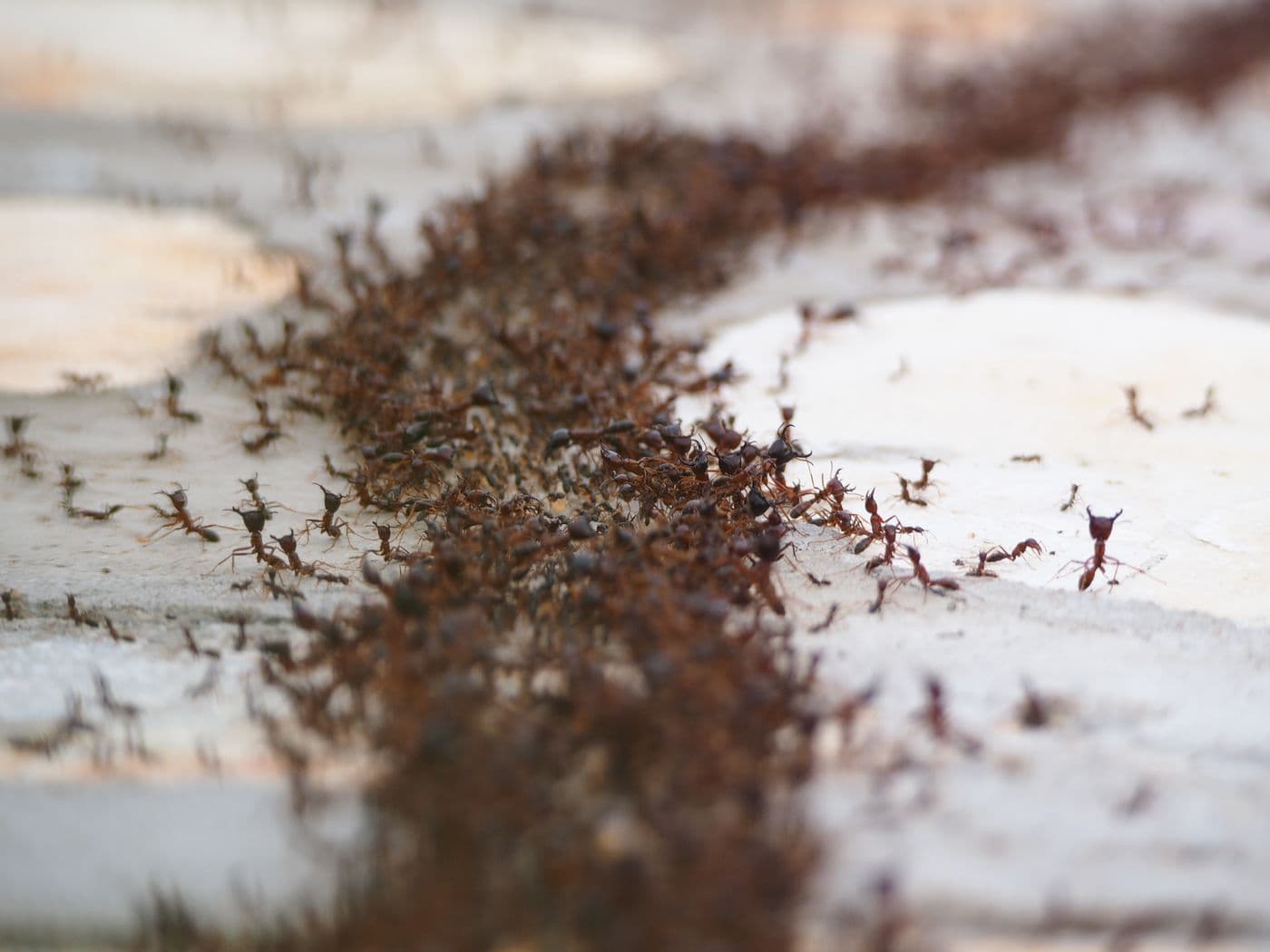
Carpenter ants degrade damp wood. Pharaoh ants contaminate food and medical equipment in healthcare buildings. Transfer bait treatments (ingested by workers and passed to the queen) are more effective than contact sprays.
Identify
Signs of infestation
- Visible ant trails following fixed routes from a food source to the nest (an active trail)
- Small excavations of fine sand along skirting boards, tile joints or outdoor paving
- Winged ants (reproductives) by the dozen on window sills during swarming season (May to August)
- Fine sawdust and wood pellets near beams (carpenter ants, Camponotus): a sign of structural damp wood to investigate
Where it's found
Black garden ants (Lasius niger): nest outdoors, forage indoors. Pharaoh ants (Monomorium pharaonis): heat-loving, nest exclusively indoors (behind radiators, in heated partition walls) and are present year-round. Carpenter ants (Camponotus): structural damp wood.
Impact
Associated risks
Health risk (pharaoh ants)
Monomorium pharaonis is a documented vector of Salmonella, Streptococcus and Staphylococcus in hospital settings. Its multi-queen colonies colonise sterile circuits in care facilities.
Structural damage (carpenter ants)
Camponotus excavates damp wood to nest. It doesn't eat the wood, but weakens beams and framing over several years. Its presence is a systematic signal of an unresolved underlying moisture problem.
Rebound effect from sprays
A contact spray kills visible workers but drives the queen away. The colony splits (budding) into 2 to 5 new colonies. Spray treatment guarantees the infestation gets worse.
Good practice
Prevention
- 01Airtight silicone joints at the base of skirting boards and around pipes: ants pass through cracks as small as 0.5 mm
- 02Fix moisture problems in woodwork before treating (carpenter ants are a symptom, not a cause)
- 03Only use bait gels for pharaoh ants: workers carry the product back to the queen, eliminating the source
- 04Never use an insecticide spray around pharaoh or carpenter ants
Frequently asked questions
What you're asking
Why do ants come back every year?
Contact spray treatment doesn't reach the queen, who keeps laying deep in the nest. A transfer bait (ingested by workers and carried back to the colony) is the only method that destroys the queen. Annual recurrence means the nest was never eliminated.
Are pharaoh ants more problematic?
Yes. The pharaoh ant (Monomorium pharaonis) is heat-loving and colonises heated buildings year-round. It's polygynous (several queens, several connected nests) and responds to contact treatments by budding — the nest splits and spreads. A specific slow-transfer bait is essential.
Are ants dangerous to structures?
The carpenter ant (Camponotus spp.) excavates damp wood to nest, worsening moisture-related damage. It doesn't eat the wood but weakens it structurally. Its presence often signals untreated water ingress.
Insect Control
Related pests
ants problem?
Intervention within 24h, guarantee included.